Solar guide
Residential vs. Commercial Solar: What's the Difference?
Both use the same technology, but homes and businesses use electricity differently. Here is how system size, equipment, and goals change between the two.
- Residential
- Commercial
- Battery storage
- Comparison
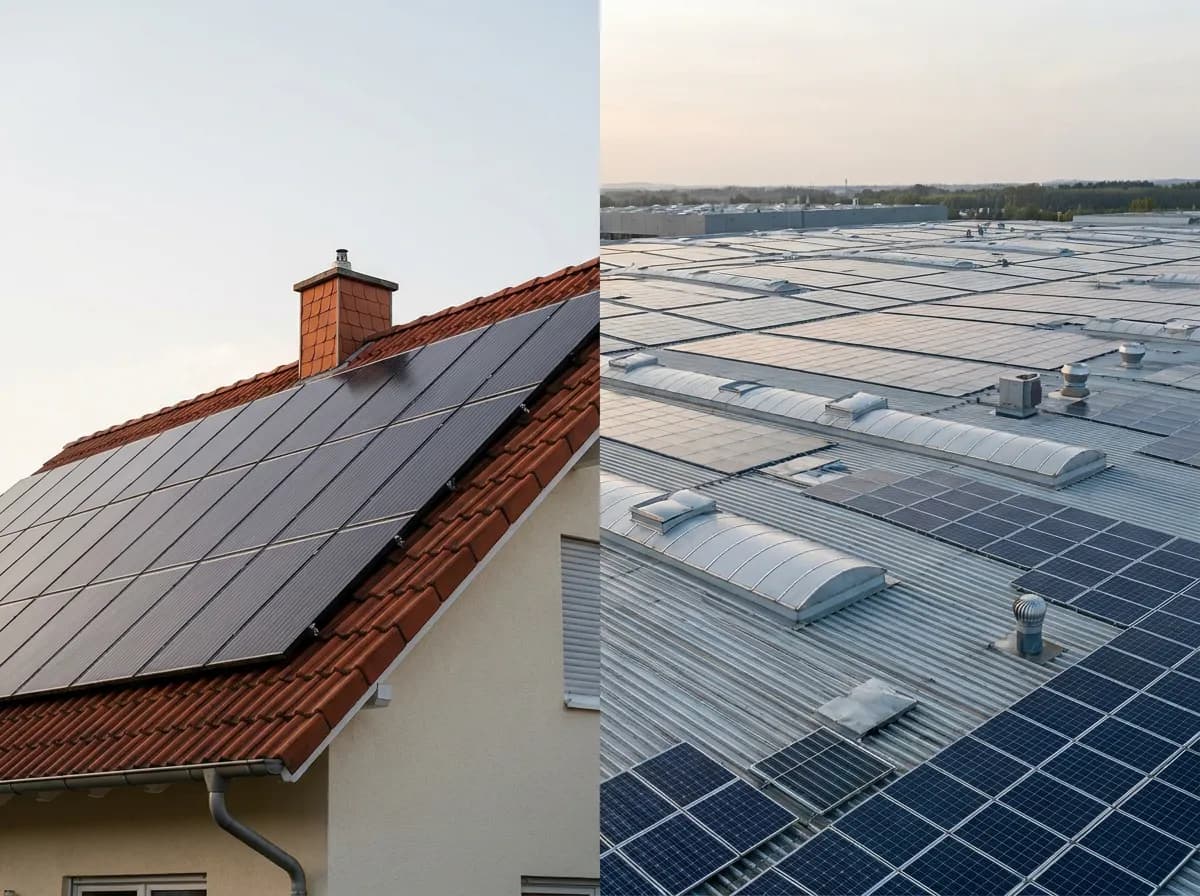
Residential solar at a glance
Size
Usually a few kilowatts, sized to a household's bills and available roof space.
Usage pattern
Highest demand in the morning and evening, so batteries add real value.
Priorities
Lower bills, backup during outages and a simple, reliable system.
Commercial solar at a glance
Size
From tens of kilowatts for small businesses to large rooftop, carport or ground-mounted arrays.
Usage pattern
Often high daytime demand, which matches solar production well.
Priorities
Operating-cost reduction, predictable energy costs, power continuity and sustainability goals.
Extras
Three-phase equipment, load monitoring, solar canopies and EV charging are common.
How to choose
Start with your last 12 months of bills, the hours you use the most power and what you need during an outage. Residential and small-commercial properties can often share equipment families, while larger sites need engineered designs.
Frequently asked questions
Not exactly. Commercial sites typically involve three-phase power, higher loads, structural review and more detailed monitoring.
Not always. Batteries make sense where outages are costly or evening use is high. Many daytime-heavy businesses start without them.
Installations are in Costa Rica. See our local residential and commercial pages for details.
Explore more solar solutions
No cost. No obligation.
Compare options for your property
If your property is in Costa Rica, we will review your bills and propose a system that fits.